Author: Guest Author

  • Why Progressive Web Apps Are Right For Your Ecommerce Website

    Why Progressive Web Apps Are Right For Your Ecommerce Website

    Website technology is forever evolving to create a better experience for users.

    One such example is the development of websites into apps and now, progressive web apps. Progressive web apps have become quite popular since their inception by Google in 2015 and why not? 

    Those organisations that have implemented PWAs have seen a minimum of 20% increase in their conversion rates. One such example is Editora Global, which saw a 40% increase in user engagement

    What are progressive web apps or PWA?

    Credit: DreamzTech Solutions 

    Progressive web apps (or PWAs) are an enhanced version of the web browser. They are built the same way browsers are but have the feel of a native app. 

    PWAs don’t have to be downloaded from an app store or even uploaded to an app store for that matter. It is simple for both businesses and users. Being an extension of the browser, it takes up very little space on your device as compared to a native app and works seamlessly which ensures a good user experience.

    Progressive web apps are not only gaining popularity because of their efficiency but also because building native apps would mean a considerable investment. All businesses cannot afford to build an app for every platform and additionally pay also for uploading their app to the app store. PWAs cost a fraction of what a native app costs and delivers more than a native app.

    Benefits of progressive web apps for your website

    Credit: Avenger

    Easily installable

    PWAs are very easy to install and let the user experience an app like feeling all while not being an app. From the start, where the user adds the icon to the home screen to the functionality, all are that of a native app.

    PWAs work offline

    A feature of PWAs that surpasses that of native apps is that PWAs have the ability to work offline. They load even when the network connection is very poor and you can access the PWA even if you do not have an active internet connection. 

    For example, if the PWA is related to news, you can view all the images and content even if the connection is lost in between or if you are proceeding to buy a product, you can add the products to your cart, offline, and can complete the payment process when you have an active connection.

    They are fast loading

    Any site that takes longer than three seconds to load is abandoned by 53% of the users. PWAs are designed to work and feel fast. The above statistic shows how short the attention span of the users are and also that no one has the time to wait and access a slow loading web page or app.

    On native apps and websites, many times, maybe due to connectivity issues or other technical issues, the pages load very slowly, which are not at all appreciated by the users. By using PWAs they will have a seamless user experience with fast loading pages and ease of use like  One such example is that of The Roasters. This business wanted a fast and responsive solution for their website, switched to PWA and benefited from doing so. 

    Cost-effective

    Native apps are not cheap to develop. If we want to reach a larger audience, we have to develop apps for both Android and iOs, but the problem is that we have to develop different apps for different platforms. 

    Another drawback is that to upload these apps on their respective app stores, another fee is charged, which does not fit the budget of all businesses. Also, there is no surety that the user will go and download the app unless given a very strong reason to do so.

    Coming to PWAs, they are cost-effective because they cost a fraction of what native apps do, and also that they are compatible with all platforms. However, they do have some drawbacks working on the iOS platform — although these are also being worked on.

    Engaging

    PWAs are fast and reliable. All these factors play an important role in user engagement. Just like native apps, graphics and videos can be uploaded to give a rich user experience, but what works even better for user engagement is that PWAs work offline too. All the images or the products are still visible and the app still works with the same speed offline — all of which can increase customer engagement by up to 50%.

    For example, Cloth Face Masks, a brand creating designer face masks, wanted increased user engagement, so they switched to PWA and achieved it.

    PWA will help you grow

    It happens sometimes that although we have an app and website, or even just a website, we are unable to draw the required traffic or we are not able to grow our business in the way we want to. Do you ever think why this is happening? This is because there are still many people who do not have access to apps and also there are some people who find web browsers slow and uninteresting.

    PWAs help you to attract customers that use mobile devices as well as web browsers. They have integrated the best of the browser and app that allows a business to grow as well as gives a good user experience to the user.

    Improves the SEO and efficiency of the website

    As PWAs increase user engagement, they in turn keep the users coming back to the webpage or searching for the business/products. This indirectly helps to drive organic traffic to the pages, thus helping in SEO.

    Also, it helps to make the website more efficient as sometimes scrolling and slow loading pages become an issue while using the browser. These barriers have been overcome by PWAs as they provide the best user experience, as mentioned in the above points.

    Popular brands that have benefited from PWAs

    Credit: e-point

    1. Flipkart   

    In 2015. Flipkart closed their mobile-only site and decided to solely focus on their native app, but even after dedicating all their resources to their native app, they did not get the desired results. This is when they thought of investing in a PWA, Flipkart lite.

    The results of the PWA was as following:

    • 3x more on-time presence with PWA as compared to their native app
    • Users spend 3.5 minutes on Flipkart lite as compared to 70 seconds on the app.
    • Flipkart lite uses thrice the less amount of data in comparison to the app.
    • A 40% re-engagement rate was seen among first-time users.

    2. Forbes  

    Forbes wanted to give their users a new user experience and hence decided to build their PWA which saw the following results:

    • The PWA page loading time is 0.8 seconds as compared to the website which used to load between 3-8 seconds.
    • There was a 43% increase in sessions
    • 100% user engagement was achieved

    3. Twitter

    Twitter was one of the first to successfully implement PWA. their monthly users sum up to 328 million out of which 80% are mobile users, the main reason why Twitter decided to focus on creating its PWA, Twitter lite.

    After building Twitter lite:

    • There was a decrease of 20% in the bounce rate
    • The per-page session increased by 65%
    • There was also a 75% increase in the total number of tweets sent

    4. Alibaba 

    With a global outreach in nearly 200 countries, Alibaba wanted to create something that focused on a rich user experience for both first-time customers and present customers. Their PWA is one of the reasons for Alibaba’s success

    • The total conversions increased by 76% 
    • The PWA drove 14% more users on iOS and 30% on Android.
    • The user re-engagement rate increased 4x times as compared to the native app

    Why is PWA the future of ecommerce?

    Credit: e-point

    PWA has changed the way people shop by giving them a great user experience, which, according to Alibaba, is the most important factor for success and also by helping to increase the traffic and visits to a webpage, like EthicSmart received 19,000 subscribers within a week of launching their PWA.

    PWA has changed the game for mobile-driven ecommerce, by concentrating on fast-loading pages and a rich user experience.

    There are many notions when it comes to understanding why PWA has such a great success rate. To get a better understanding of the same, given below, are a few reasons highlighting the features that have been the success factors for PWA:

    • Decreases bounce rate 
    • Increases user engagement and re-engagement
    • Increases the total time spent on the app
    • Higher conversion rates
    • User-rich experience
    • Fast loading time
    • Works even with poor connectivity
    • Works offline

    Let me list out few reasons as to why PWA is considered the future of ecommerce:

    1. Takes up less space

    Since PWA is an extension of the browser mistakes up very little space on your device. One of the main reasons people don’t install apps and also uninstall apps is due to the space it takes up on their device

    2. Works like a native app

    Everything about the PWA will give you the experience of a native app. From when you click on the prompt “add to home screen”, it starts downloading as would be seen if we install an app from the app store, the icon gets added to the device’s home screen like an app and it works, looks and feels just like a native app but without taking up space or consuming the data as a native app would.

    3. Fast loading time

    As mentioned above, in the success story of Forbes, their fast loading time of 0.8 seconds played an important role to ensure that the users came back to use the app. PWAs are built to load very fast. In this day and age, no one has the time to wait, if they do not get what they want fast, they will look elsewhere.

    4. Costs less

    The cost of building a PWA is lower than that of a native app. In fact, it may cost a fraction of what the native app would. Having said that, different platforms require different apps and with this comes the cost of uploading those apps on the app store — and there is no certainty that they will be downloaded. PWA cuts all these costs, ensuring any business of any scale can build a PWA.

    Concluding remarks

    PWAs being fast-loading, costing less, ensuring a great user experience and delivering to the users are only a few of the reasons for their success in ecommerce. 

    PWAs have changed the way users perceive their shopping experience. Native apps had certain issues like they cannot work in low connectivity or offline, as well as taking up a great deal of space on devices, all of which are not favourable for the users or their shopping experience. 

    Technology being dynamic, PWAs continue to change every day, always with the focus on changing the experience of mobile-first ecommerce. You can learn more about how this technology can help your business by checking out the Cenia PWA theme by CedCommerce

    Author bio: This article was written by the team at CedCommerce, a one-stop-shop for ecommerce solutions. 


  • A Comprehensive Guide To Boost Sales In Your WooCommerce Store

    A Comprehensive Guide To Boost Sales In Your WooCommerce Store

    Are you experiencing a major dip in your WooCommerce store sales? Or are you looking for ways you can improve your business? Whatever category you belong to, you can have it all answered by going through this article. 

    This post elaborates on the most effective ways you can boost sales for your WooCommerce store. It will help you understand the reasons behind the lowering sales of your store and suggest better ways to improve it. Give it a quick read and save your store from losing more sales. 

    Offer coupons, deals, and discounts

    Offering coupons and discounts in your store never fails to capture the attention of your customers. If the coupons are compelling enough, shoppers are likely going to use them for themselves and even share offers among their family and friends. 

    Coupons can be used to attract new customers and for maintaining existing ones as well. To attract new customers you can come up with a ‘buy one, get one free’ deal, free shipping, first-order discounts, etc.

    Credit: Freepik

    To ensure customer retention you can make use of coupon strategies such as customer 

    purchase history-based discounts (nth order discounts), store credits, gift cards, etc. 

    WooCommerce has coupon functionality built into its core — and for advanced coupons, you can choose from several coupon extensions including smart coupons and discount rules. 

    Cart abandonments being a major threat to sales, you can create and offer coupons that bring the abandoned cart owners back to your website. If people don’t make it back to complete their purchase you can entice them to do so by sending attractive coupons via email. This extra push will bring back customers who left their cart due to trivial reasons. 

    Coupons are great sales boosters, but while creating coupon strategies, you should also consider if this aligns with your revenue margin and business goals. If you continue to offer mind-blowing deals with little regard for your financial state, it can cap your efforts for store growth — and even leave you in the negative. 

    Speed up your website

    Credit: Freepik

    Site speed or loading time is a crucial element for any website, but when it comes to an online store it becomes a deal-breaker. People won’t spend another second in your store if it’s loading slowly. Their immediate action would be to exit your website and go to one of your competitors.

    So how do you avoid it from happening to your store?

    Well, for starters, initiate frequent monitoring of your site speed. There are many tools available to help you with it. For example, Pingdom, Google Pagespeed Insights, and GTMetrix are some of the popular ones available for this purpose. 

    With these tools, you can even monitor other areas of your website such as sign up, search, and checkout, etc. But once you know your page speed is low, how do you go about fixing it? How can you stop it from happening again? It is indeed a relevant question that you need to answer if you don’t want to lose any more of your sales and revenue. 

    Your website speed is hugely affected by the choice of your theme and your hosting provider. Themes aren’t just responsible for the look and feel of your website — they also influence your page speed. So when you are switching a theme or starting a new store, go for a theme that’s not only visually appealing but fast as well. 

    When it comes to hosting providers for Woocommerce, speed is a major selling point for them. All providers boast of their excellent hosting speed, while only a few of them keep their promise. Whether you are planning on migrating to another host or looking for a new one for your website, do your research. Ask current and past users, as well as looking at reviews on genuine review websites before deciding on one.

    Some other things you can do on your website to improve its speed are website caching, image optimisation, and code optimisation. 

    Bring visitors’ focus to store/product reviews

    Credit: Freepik

    Getting your shoppers to trust your store and its products is very important to boost sales. If they don’t find any reasons to trust your store, it will leave them confused as to whether or not to purchase from your store. 

    The proven way to instil trust in your customers is by displaying trust signals like customer reviews and testimonials on your website. When they see a real person sharing their experience with the product or the store it will make them feel safe to spend their money on the product.

    Make sure you only display verified reviews on your website and allow for video testimonials and other user-generated content. Many WooCommerce plugins help you to easily enable this for your store. 

    Don’t overlook user experience

    User experience doesn’t need much introduction. We have all gone through good and bad experiences while interacting with physical and digital products of all kinds. Whether a product stays in the market or not is hugely influenced by how easy it is to use. The harder it gets to use the faster users look for alternatives.

    When it comes to a WooCommerce store, the theme holds the responsibility for ensuring a better user experience at your store. If your chosen theme is not a great fit for user experience, you can always customise them to meet your user requirements. It can be hard to find a theme tailored to the needs of your target users, so the best way can often be to customise them. 

    There are certain areas on your website that are crucial to user experience — such as its navigation, search feature and call-to-action buttons. A confusing navigation system will make it hard for users to find their way around your website. If they are unable to find the product they want, there is no point in them staying on your website anymore, and they will simply leave. 

    To ensure a better user experience you also need to have a clear call-to-action on your site. The ‘Add to Cart’ and ‘Buy Now’ buttons should be properly placed and visible to your users. They shouldn’t get drowned out by other decorative elements on your website. 

    Products should be easily searchable and product descriptions should be crisp and to the point, that help your potential customers to make their purchase decision easier and quicker. You can also conduct usability tests at frequent intervals to learn more about your users’ needs and make necessary changes in your store to meet them. 

    Never compromise on security

    Credit: Freepik

    Security is one of the few elements that should never be compromised if you are aiming for the faster growth of your WooCommerce store. Even a minor security breach on your website could have a huge impact on your store’s credibility, and your customers will hesitate to make purchases from your store for fear of exposing their card information. 

    If you want your customers to trust your store and spend their money without concern, you need to ensure that your store has a highly secure infrastructure. But that alone won’t do —  you need to let them know about the top security measures that you have taken to keep their data safe on your website, especially at points where they may feel vulnerable, such as checkout, login, and registration.

    When it comes to your website security SSL (Secure Socket Layer) certificate is a must. The lock icon displayed beside your website’s URL implies that your website is secure with SSL. It’s a very common and fundamental security practice that every website should follow to ensure its security.

    Another important thing you need to do to prevent your website from any kind of security attack is updates. Timely updates can keep your website safe by providing immunity from all new kinds of malware, viruses, and similar forms of security threats. If you use third-party services or plugins in your store you need to take extra note of their updates and keep them updated. 

    Even if you do everything you could to keep your website secure, you can never be 100% sure. There will always be some parts of your website that you may have overlooked or a new kind of threat that you didn’t prepare it for. If the worst happens, it’s better to keep a backup of your site data to minimise the loss. 

    There are a plethora of plugins that offer automatic backup facilities along with other important security features such as website firewall, malware scanner, IP blocking, etc. Sucuri and Wordfence, are some of the popular ones, but there are many available. 

    Ensure easy checkout flow

    Credit: Freepik

    The checkout page is the most crucial point for any WooCommerce store. If your customers don’t go past that point, all the efforts that you took to bring them up to the point will be wasted. Your store’s increasing cart abandonment rate is a sign that your checkout page needs an immediate checkup followed by its optimisation.

    How do you optimise your website’s checkout page for better conversions and fewer abandonments? It would be better to start by providing a faster checkout process. Customers wish to spend more time on choosing the products, reading their specifications and comparison, that they have little time left for checkout. Adding the WordPress Shopping Cart plugin to your store helps you achieve this. 

    If you force your potential customers to fill out larger forms, you will be disappointing them to the point that they will either cancel the purchase or postpone it to a later date by leaving the item in the cart. This points to the importance of providing shorter checkout forms and allowing guest checkout at your store. 

    Another important checkout element you need to consider is the number of payment methods that you have allowed in your store. If the customer is unable to find a payment method suitable for them they won’t proceed with the purchase either. Make sure that you allow all popular payment methods used by your target customers on your website. 

    Since most customers feel vulnerable entering their card information, owing to security concerns, displaying trust badges is a great idea. You can also highlight your return policy like easy returns, and a money-back guarantee., as a trust booster. This will give them a sense of security and help them continue with the process peacefully. 

    Improve WooCommerce SEO

    Search engine visibility is a key factor in bringing traffic and thus boosting sales of your WooCommerce store. To rank higher in search results you need to optimise your website’s content for it. 

    When it comes to a WooCommerce store, product pages are the most relevant pages to be ranked. You can give special attention to its meta-descriptions and craft product descriptions in a way that pleases both your customers and the search engine bots. 

    Monitor and analyse marketing performance

    Credit: Freepik

    At this point, you analyse whether all your efforts are bearing fruit: what did well? What failed? And what needs to be improved? Going through this analysis is important to keep your store on the growth curve. Always remember: ‘What gets measured gets managed’. 

    Along with the variation in the sales graph, you should also monitor other statistics such as conversions, traffic, bounce rate, and cart abandonment to make sure you are going in the right direction. Keeping track of all the data helps find out issues with your store, and provides valuable insights into troubleshooting. 

    You can use a variety of tools to analyse the data. Google Analytics is the most popular among them. You can integrate your WooCommerce store with Google analytics using the MonsterInsights plugin. 

    Patience is key in these situations, sometimes it might take some time to see the results. Even if it didn’t work out as you expected, don’t lose hope. It might be some small issues that you may have overlooked causing it all, find them out and fix them. 

  • Underused Ways To Engage And Retain Customers In Ecommerce

    Underused Ways To Engage And Retain Customers In Ecommerce

    How well do you engage and retain your customers? A recent survey among DTC brands found 28% to be the average customer retention rate. If you’re below that, your ecommerce business will probably benefit from upping its game at engagement and retention.

    But we will not be talking about tactics like using reward points or fighting cart abandonment with a discount. They’re pretty clear and overused. We’ll go over some underused ways to engage and retain customers in ecommerce that are actually very effective.

    The idea is to trigger targeted emails at specific times to engage the customer in a more natural, relevant way. There are so many opportunities for authentic interactions between brands and buyers that companies miss out on. Here are some examples of moments in the customer journey and how you can react to them in order to continue building the two-way relationship.

    Content engagement

    Most ecommerce businesses go down the road of constant, non-stop promotions. Once they get a lead’s email, they start bombarding them with offers all the time. Of course, getting sales is the ultimate goal but let’s be realistic. 

    People can only shop so much. Going through all your products categories and varying the discount in two emails a day is counterproductive. They will get bored, probably even annoyed. Research shows that 69% of US shoppers would unsubscribe from a company’s newsletter because of too many emails.

    A better approach would be to alternate sales messages and non-promotional content. This way, you engage your audience without wearing them down with CTAs. This content can be information about your products and industry, new research you’ll be using, projects you’re involved in, partnership announcements, events, etc. 

    Anything about the interests you have in common with your customers will also do — maybe it’s a love for travelling, or sports, or skincare, or a particular type of music. Developing your content pays off because brand awareness and loyalty can soar when you blend brand and lifestyle. 

    So, in between promotions, send emails that are pure fun or useful advice. People will learn to open and read those emails since they’d be genuinely interested. And you’ll be the brand that comes to mind when they finally decide to buy something.

    Credit: ReallyGoodEmails

    Restock reminders

    If you sell everyday items like personal hygiene products, pet products, food or drink items, etc. retention should be a top priority. Your products are meant to be used all the time, after all! 

    The least you can do is to set up automatic emails to trigger at a certain time after making a purchase. How long does your deodorant last? Set the email to go off a few days before that to remind people they need to restock if they don’t want to wake up to no deodorant. You can get creative here and play with urgency CTAs to get their attention with every email.

    Credit: Clicks

    These type of restocking reminders are useful for the customers (so they receive them well) and increase your retention and sales.

    “Buy as a gift” offer

    After a customer buys from you, you might find yourself in a position where you don’t have another product to offer them. This is the case of one-product stores and many DTC brands that start out with a small product range. Take Palmpress, for example. It sells a proprietary coffee press, two accessories and one kind of coffee. This means it could be difficult to convince people to keep coming back to Pampress once they’ve bought these products. 

    You can suggest that your (only) product will make a good gift. When looking for gifts, people are often worried about how to choose something good. If they’ve tried the product before, they’d be more at ease, which is a great advantage over other products. It should be an easy conversion so definitely reach out to your old customers especially around the holidays to give them the idea.

    Gathering and using feedback

    For a strong relationship with the customer, you should be open to feedback. People love sharing their opinions and that can actually help you. First, they are much more willing to give feedback after a negative experience — it’s just human nature. So you’ll know where to start improving. You will get ideas for products and services as well, which is great if you don’t know how to grow from here.

    Also, asking people to share their thoughts makes them feel heard and important. This can be especially if you add a personal thank you, for example. They’d want to see if you implement any of it so they’d stay engaged with the brand. And even if that one experience had not been optimal, those customers might forgive you and come back because they see the effort on your part. 

    Feedback was the tactic Native used to become the wildly successful brand it is today. It went through over 20 formulas for their deodorant until it finally was what people loved and sales went crazy.

    User-generated content challenges

    UGC works both ways: it makes people think about and use your products more, but it also is authentic social proof for others. 

    It’s a great way to retain customers. They like it because they’ve already bought the product, no need to buy it again. And the exposure is intoxicating, especially in times when many people aspire to be a micro-influencer. 

    On the other hand, others will see your product in various settings, used by normal people, even someone they know. This is both persuasion and inspiration. It’s not just the perfect studio pictures they see on your site, the product is a lot more engaging when they see it as a part of life.

    Below is an example of Boden’s user-generated style gallery. Products are tagged on the photos.

    Credit: BodenUSA

    These under-the-radar tactics could engage and retain your customers better than some of the more popular methods. Their power is in the fact they bring positive emotions for the customer, unlike some cold sales calls that are too harsh, intrusive and unhelpful. Try them for yourself!

    Author bio: Murry Ivanoff is the CEO of Metrilo, an ecommerce analytics, CRM and email tool in one. Metilo helps ecommerce brands grow through customer engagement and retention.

  • How To Make Custom Packaging A Core Part Of Your Brand’s Image

    How To Make Custom Packaging A Core Part Of Your Brand’s Image

    The world of custom packaging is vast. Really vast. 

    But it’s imperative that online retailers understand this: ecommerce packaging is more than just a protective box. 

    And that’s true for two reasons. 

    One: packaging is a potent ecommerce marketing tool, as it’s the only channel that reaches 100% of your customers.

    Two: the typical ‘box’ is just the tip of the iceberg. 

    In this article, we’re going to take a close look at the ‘why’ of those two previous points, and show you how you can make custom packaging work for your brand

    The unboxing experience

    You’ve more than likely heard that phrase several times before reading it here, but what the unboxing experience actually is — and why it’s important — isn’t always straightforward. 

    Remember the anticipation you had around Christmas or a birthday as a kid? The excitement of knowing you’re getting something — you have no idea what, but you were so darn excited. 

    That excitement is an emotional response, and what happens to you in this phase of irrational childhood holiday excitement leaves an impression on you. 

    That same thing happens now as an adult — when that Amazon delivery arrives, there’s that ‘ohh’ bit of excitement, even though you know what you’re getting. 

    Why it’s important 

    The unboxing experience adds value not just to your product, but to your brand. It’s the stage that thrusts your product into the life of your customer and says ‘here I am, the thing that you brought, and buying me rather than a competitor was the right decision’. 

    When selling online, you’re limited by the number of touchpoints your brand has. More specifically, you can’t physically interact with customers before purchasing the way that retail brands can. 

    So by paying special attention to that first physical touchpoint (the packaging) helps you leave a lasting first impression and stay in the mind of your customers for longer.

    Credit: packhelp.com

    Custom packaging is also one of the most recognisable brand elements and is important when building customer loyalty. Haagen-Dazs is one of the best examples.

    Credit: CandyBar

    A 2016 survey found that speedy fulfilment and quality packaging brings almost 40% of customers back to make subsequent purchases. It also helps a brand feel more upmarket and premium. 

    But premium packaging doesn’t have to have a premium price tag. Effective packaging design adds value, yes, but effective packaging design is also packaging design that works in harmony with your branding. 

    Below is a fine example of that. Blue Moon Spiritual takes the graphic design of their website and their business branding and echo it on their packaging — both inside and outside. 

    Credit: packhelp.com

    The result is an added sense of value for the customer and a consistent brand experience, from online purchase to that first physical touchpoint. 

    Many brand owners are apprehensive at the environmental costs of custom packaging — and their concern isn’t without warrant. 

    Sustainability and packaging

    In 2018, packaging waste generated was estimated at 174 kg per inhabitant in the EU. This is an alarming number of purely packaging waste. 

    Much of this waste can’t be recycled or costs a lot of energy to recycle. PLA (single-use plastics) in the form of water bottles and the like, being the main culprit. 

    Credit: packhelp.com

    While custom ecommerce packaging is part of this statistic, it’s important to note that the humble cardboard box is one of the most eco-friendly packaging solutions. 

    • FSC certified cardboard is made from either ethically sourced virgin pulp, or recycled content
    • Petroleum and animal-based adhesives don’t work with wood pulp; only natural glues are used
    • Large-scale printing facilities use soy-based inks by default

    But, as you read earlier, there’s more to custom packaging than cardboard boxes. Tissue paper, wood wool and other inserts are also fibre-based materials and can easily be recycled. 

    Credit: packhelp.com

    Biodegradable mailing bags made from corn by-product are becoming a popular alternative to single-use plastic mailing bags, as they can biodegrade in the right conditions. 

    Below you can see how Feeling Felt combines recycled cardboard and a biodegradable poly mailer as both primary and secondary packaging. 

    Credit: packhelp.com

    Mushroom-based packaging is also growing in popularity, as is building reusability into your packaging design. Innovative plant subscription boxes encourage you to grow plants in the boxes that are mailed to you. 

    Below, you can see how British childrenswear brand, Monday’s Child, turned their mailing box into a dollhouse that their young customers use. 

    Credit: packhelp.com

    Building reusability into your packaging design, as well as using recyclable and recycled materials ensures that your packaging does as little harm to the environment as possible. 

    Plus, you’ll be sure that your packaging ends its life in the most appropriate location. 

    More than just a box

    Packaging is the material used to store your product between it being manufactured and being used for the first time.  Most often (but not always), it consists of primary and secondary packaging. 

    Primary packaging is the packaging that has your product (and only your product) inside it. 

    Secondary packaging is the external packaging that’s used to keep your primary packaging secure throughout delivery. 

    But boxes aren’t always the best solution. Here’s a breakdown of the go-to packaging supplies for both primary and secondary packaging. 

    Ecommerce delivery packaging 101

    Regardless of what you’re selling or where you’re sending it to, there are a few standard packaging solutions that online retailers can use (and customise):

    • Corrugated cardboard boxes
    • Mailing bags
    • Tubes

    There are also other packaging expenses to take into account:

    • Void filler:
      • Bubble wrap
      • Wood wool
      • Packaging peanuts
      • Tissue paper
    • Insulation
    • Packing tapes & delivery pockets

    Let’s take a closer look at some of these and see some examples. 

    Corrugated cardboard boxes

    Corrugated cardboard is the go-to secondary packaging for just about anything. For custom shapes, dimensions, prints and finishes, corrugated cardboard can do it all. 

    Credit: packhelp.com

    Mailing bags

    Corrugated cardboard isn’t perfect — it’s heavy and can take up a lot of space in warehouses. Many brands that sell smaller and more durable products (clothing, accessories etc.) opt for some form of mailing bag or envelope. 

    Spanish fashion label Sunad knows their clothing doesn’t need the protection of a heavy cardboard box, and instead send their apparel to customers in an expandable mailing bag. 

    Credit: packhelp.com

    Anthem, another Spanish designer, sends their clothing in a biodegradable poly mailer. Anthem knows their clothing can handle being thrown around in the back of a delivery van, but it still needs protection from dust, dirt and water. 

    Credit: packhelp.com

    Void filler

    Sometimes there’s a little space inside your box that needs to be filled — bubble wrap, while incredibly soothing, isn’t the most environmentally friendly way to take up space. 

    Custom tissue paper adds another layer of branding and is entirely recyclable. 

    Credit: packhelp.com

    Wood wool, which is sheared wood, can be recycled just like paper pulp. 

    Below you can see how German brand Concrete Jungle uses dyed wood wool (dyed with recyclable inks, too) to add a little class and elegance (and security) to their unboxing experience. 

    Credit: packhelp.com

    Insulation

    Some products need to be thermally regulated throughout the delivery process — mainly medical products, health supplements and food goods. 

    Psibufet (Buffet for dogs) is a Polish subscription box company that delivers fresh, organic dog food monthly. The struggle is keeping that fresh food cool enough in the 48-hour window between it leaving the cool storeroom and arriving at its destination. 

    Credit: packhelp.com

    Rather than using styrofoam, packaging engineers found that honeycomb cardboard corrugations did a great job and kept the goods below freezing for the required 48 hour period. 

    Tapes & delivery pockets 

    You can never be too safe. Many companies add that extra security level by sealing boxes or bags closed with a little extra tape. But if you’ve put all that time and effort into branded packaging, unbranded tape stands out. 

    Credit: packhelp.com

    Another expense to be aware of is the simple little plastic pocket that’s used for delivery documents. If you’re shipping internationally, it’s crucial that you provide an external pocket to hold customs declarations and such. 

    Don’t forget pretty primary packaging either!

    You’ve just read a whole lot about secondary packaging — the packaging that’s used in transit. But primary packaging, the last barrier between your customer and your product, is just as important. From custom QR Codes for smart packaging, playful colours to recycled and vintage packaging, there are a plethora of options that you can try to create a personalised experience for your customers.  

    Credit: packhelp.com

    It’s this packaging that presents your product to the world; it builds anticipation and reminds the customer that they’re holding something special (because they are). 

    Here you can see how Hemp Juice uses its primary, secondary packaging, and CBD Oil label design to create a comprehensive experience across all packaging and labelling forms. 

    Credit: packhelp.com

    The British telecom brand, Snakehive, uses two-piece product boxes that are coloured to complement their products’ colour palette.

    Credit: packhelp.com

    A brand like BMW is one you’d expect to spare no expense in providing a luxury experience. 

    And when sending keys to motoring journalists to test drive the latest M5, no expense was spared. BMW delivered the keys in a rigid drawer box, complete with a hot-stamped foil print and a velvet-lined interior.

    Credit: packhelp.com

    Conclusion

    Packaging plays a massive role in your business. It is not just getting products from A to B, but also delivering a branded experience, retaining customers, and being part of your sustainable values. 

    It’s an expense that your ecommerce brand has to bear. Still, when done right, it can have a tremendous positive impact on your brand notoriety, customer satisfaction, and ultimately, your bottom line. 

    Author bio: Phil is a bearded Australian living in Warsaw, Poland. When he’s not trying to take Packhelp’s custom packaging to the world, he can be found trying not to kill his plants or writing for his blog expatspoland


  • Why Websites Fail And How To Fix them

    Why Websites Fail And How To Fix them

    If you’re building a website for a client or a business, it’s safe to assume you don’t want the site to be a failure. But have you ever wondered why some websites fail?

    There are a lot of reasons why websites are not successful. Three of the key reasons why websites fail are poor website design, inadequate search engine optimisation (SEO) and not optimising for mobile. 

    This article explains how to avoid these mistakes and how to fix them, so you don’t create and maintain a failing website. 

    The importance of website design

    Design is one of the most important parts of any website. Get it right and people will adore your site. Get it wrong and they might visit once and never return. We’ve focused on the importance of colour scheme to your website design and explained how you can get it right. 

    How colour scheme works 

    Colour is a very important aspect of your website. If you select the right colours then your users will have a good impression of your website and could be more likely to buy your products. The big reason why colour can affect if someone wants to stay on your website is mood. Colours can cause a mix of emotions in your visitors depending on which ones you use.

    However, if you mix the wrong colours together, they might affect the visitor’s mood in a negative way. The user might look at your website for a second and leave it right away just based on the colour scheme. 

    Credit: Visualwebz.com

    Examples of bad and good colour schemes

    Having too many colours on the website, too many bright tones and shades that don’t go well together are all examples of bad colour schemes. For instance, a website that has too many bright colours or a site where you can’t read the text because it blends in with the background colour. This is not good for user experience, and will deter your visitors (as well as making you look unprofessional and inexperienced). 

    A good example is Amazon. It uses orange, which gives off a sense of joy. This could encourage people to buy products when they visit Amazon.

    How to choose good colour schemes

    How do you choose the right colour scheme for your website? Depending on the type of people you want visiting your website, you would want colours that resonate with those users. For example, if you want children to visit your website then you could choose fun, bright and warm colours. 

    The importance of SEO 

    You need to have a website that has good search engine optimisation (SEO). If you don’t then your website won’t rank well in search engines, and your target audience won’t find it. 

    How SEO works

    Search engines have a crawler, which is a bot that checks the internet and gathers information about websites. This is brought back to the search engine to build an index. Once the index is built, it is run through a program that matches the information that was gathered.

    Examples of bad SEO

    What is bad SEO? There are plenty of examples and we’ve highlighted two of the key ones: 

    • Duplicate content 
    • Keyword stuffing 

    Duplicating content from other websites — as well as duplicating information from your own website — is an example of bad SEO. This is because search engines want to provide their users with unique and valuable information. 

    Keyword stuffing is when you include a lot of keywords, so much so that it looks unnatural. Search engines penalise this because it looks as though you’re writing content for them, not for their users. 

    How to get a better search ranking

    There are a few things you can do to boost your search ranking. 

    The main one is having the right keywords and using them naturally. These are the terms your target audience are searching for and that you want to be associated with your website and web pages. 

    You can find the right keywords by conducting keyword research, which is where you look for the terms your audience might search for. 

    However, you do not want to use too many keywords. As we explained earlier, keyword stuffing makes your content unnatural and this will have a detrimental effect on your rankings. 

    Another thing you can do to help your ranking is to make sure your website has a good structure/layout. 

    This is important because this makes it easier for the crawler to figure out what your website is about and index the content. A good website structure will be hierarchical, similar to a pyramid, with the important information at the top of the website and less important at the bottom.

    Finally, you must also think about user experience (UX).

    This is because Google now checks user experience for Google search ranking. If the user does not have a good experience on your website then Google won’t rank you as well

    The importance of optimising for mobile devices

    More people are now accessing the internet through their mobile devices than their desktop PCs. It stands to reason then that your website must work on every device it can be accessed by. 

    Examples of websites not being device-friendly

    The biggest example of a website not being mobile-friendly is that it doesn’t look and act the same on mobile as it does on a desktop. There are a couple of ways you can spot this. When the website is opened on another device:

    • Some page elements disappear
    • Fonts change 
    • Things look clustered

    Why do websites need to be mobile-friendly?

    It is crucial to optimise your website for other devices. As we explained earlier, more searches are now conducted through smartphones than PCs. This means if your website isn’t optimised for these users then you’re missing out on a lot of traffic for your website. 

    You want to get your business out there to your customers and have an advantage over your competitors. Your customers expect that you have a website that is device-friendly and search engines demand it — Google penalises websites that aren’t optimised for mobile

    Credit: Visualwebz.com

    Solution

    To fix this problem, you need to make sure your website has a responsive web design. This means that your site should be designed to change according to the device it’s opened on. To achieve a responsive web design, you need to change the layout using CSS or a CSS media query which is better than just regular CSS — as well as keeping your web design simple and uncomplicated.

    Takeaway

    In conclusion, a website is likely to fail if it has a bad design, poor SEO and isn’t mobile-friendly. 

    So, make sure your website has a good colour scheme, is search engine optimised and has a responsive web design. If you don’t then you risk creating a site fewer people visit and even less come back to. 


  • Mobile Loyalty Marketing For Ecommerce Businesses 

    Mobile Loyalty Marketing For Ecommerce Businesses 

    Customer loyalty is a customers’ willingness to do repeat business or sales with a brand. According to a loyalty report, 79% of customers claim that they are more likely to continue doing business with brands that use loyalty marketing. 

    And since we live in a digital world where mobile phones have become an extension of us, ecommerce businesses need to use mobile as a channel for their loyalty marketing programs. 

    With over 3 billion smartphone users in the world right now, people spend an average of 3 hours and 15 minutes on their phones. We shop on our phones, check our emails, read the news, create our resumes, watch films, make appointments, and the list can go on. It means a mobile marketing strategy is essential and you need one that can turn people into long-term customers. 

    In this article, we want to talk about:

    • Loyalty programs that fit your business
    • Approaches to stay relevant
    • New mobile loyalty ideas for next-level engagement

    Loyalty programs for ecommerce businesses

    Firstly, what loyalty programs could fit your business?

    Multiple loyalty marketing programs could apply to your online business. It could be:

    • Point-based loyalty programs: customers earn points, and then they spend them on your site.
    • Tiered loyalty programs: perfect for exclusive brand experiences and VIP rewards.
    • Perk programs: you give all your customers benefits and discounts to make the shopping experience more enjoyable.
    • Hybrid programs: you can mix and match all the above.

    Enhance your mobile loyalty marketing with gamification

    Gamification is a powerful way to enhance your mobile loyalty marketing, grow your ecommerce business and retain more customers. Make the experience 1.7x more enjoyable for customers with badges, online challenges, prize wheels, voting, and more. 

    Using gamification for brand loyalty is crucial. You can track customers’ progress and use reward levels to gamify your loyalty program. For instance, customers can reach different tiers depending on how much they spend annually. Rich Media Messaging (RMM), or the SMS 2.0, how we like to call it, is next-level engagement for gamification. 

    Go ahead and send a rich message where you can also notify customers of their progress. Include visuals like progress bars to motivate them to earn more benefits. You can reward a customer by:

    • Sending discount codes
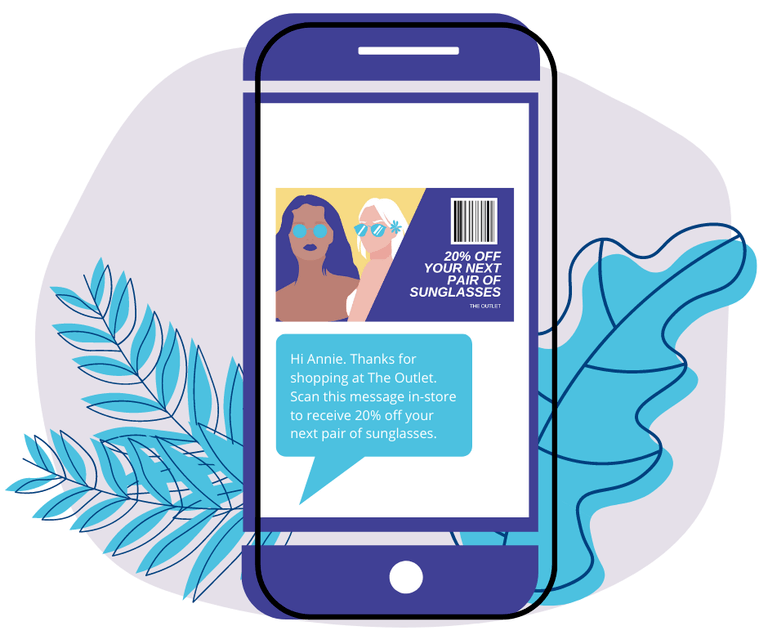
    • Sending gift card barcodes to redeem in-store or online

    Source: www.voicesage.com 

    Send automated customer discounts via SMS

    Delivering discounts via SMS is a great incentive, as customers love to save money and communicate on a large scale. Giving that it’s such a familiar channel that everyone is using, take advantage of its benefits. 

    For instance, choose SMS to send an automated discount code to a customer when they sign up to your loyalty program or offer 20% off their next order when they make a purchase.

    Incentivize reviews 

    Start collecting user-generated content such as reviews. This way, you increase product engagement, differentiate yourself from the competition, and it allows you to engage with your customers at a personal level.

    The more positive reviews you have, the better the customer engagement. Share that on your top-level pages or throughout the entire website to create an on-going positive experience.

    Source: www.voicesage.com 

    Increase customer retention

    Customers become loyal to an ecommerce business when the products are high quality, delivered as quickly as possible, and when you invest in making the customer experience as smooth as possible.

    These are just a few of the factors that increase the likelihood of retaining customers. Implementing a customer loyalty rewards program that works for your brand starts with knowing your customers. Take a minute and analyse your data and analytics. See how your customers react to promotions, what they like and dislike, and what your competition is delivering. 

    This process will give you enough information to design the best reward program.

    Conclusion

    In conclusion, repeat orders are more like to happen when customers see a benefit from a loyalty marketing program. Start investing in mobile programs as they are cheaper, more scalable, and instant. Then you will see positive growth.