Category: Marketing

  • Preparing Your Online Store for 2022 – Top 7 Ecommerce Trends

    Preparing Your Online Store for 2022 – Top 7 Ecommerce Trends

    Making purchases online is gradually gaining momentum amongst all age groups now, partially due to COVID accelerating its adoption. Since last year, people have adopted the online route to buy goods as opposed to buying at retail stores only.

    But somewhere this implies that retailers need to be more alert while setting up their online store. In this article, we will put light on the finer details of the most in-demand ecommerce trends for 2022.

    We can say that ecommerce has been optimized over these years for better reach and consumer ease. We have witnessed some high-impact transitions from email alerts to pop-up notifications; tiring sign-ups to OTP logins; lengthy menu items to categorize products, etc.

    Trends change every year and so does selling through ecommerce. In the last few years, there have been transformations through improvisations in user experience, payment methods, cloud services, etc. All of these have brought in a significant rise in overall online sales and will continue to do so.

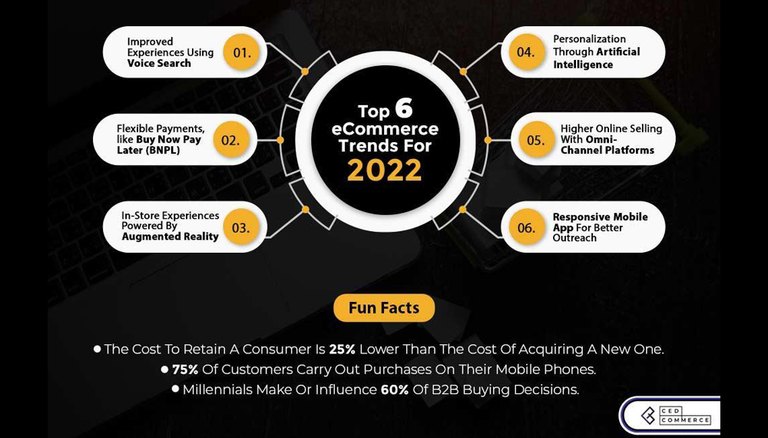
    Ecommerce trends for 2022

    1. Responsive search

    From the perspective of a shopper, have you ever noticed that the time taken to locate the product of your choice is greater than the time taken to make the actual purchase? Searching across vendors, products, the related comparisons, etc. is indeed quite a long process. On the contrary, think of it from a retailer’s perspective. He would eventually want the lead to travel down the funnel in order to meet his targeted sales metric.

    Consumers navigating through a large e-Store is a cumbersome process. Even today, 61% of ecommerce sites have weak support for search synonyms that make navigation easy for online shoppers. With the rising intervention of technologies such as Artificial Intelligence (AI), Augmented Reality (AR) into eCommerce, customers are expecting their product search to find an exact match in the least possible time.

    Hence, a quick and relevant search is a must-have for all shopping platforms. Customer Experience is amongst the top priorities of online businesses, adapting the search for a better fit is eventually going to fine-tune this experience. Leveraging AI for making the search more responsive is an easy way to understand your consumer better.

    With the use of AI, the search box pre-populates with the customer query and minimizes the customer effort to type in the entire product. To make it more efficient, try feeding in product codes, color variants, sizes etc. into the AI model to display some of the more relevant results and eliminate broad search results. By virtue of an intelligent search, consumers will feel good about choosing your platform over others.

    2. Omni-channel selling

    Simply put, Omni-channel refers to selling products through both offline and online channels. This strategy is focused on making the customer’s experience seamless by virtue of comfort buying. It provides the flexibility of reviewing the product in-person while making the purchase online.

    Going by a report from the National Retail Federation, online and other non-store sales have increased by 20% as compared to last year. There is no denying the fact that COVID did accelerate the online transition for both businesses and customers. However, customers are now on the lookout for an optimal mix of an offline and an online store. This allows more flexibility and gives the customer a superior buying experience.

    So, if you haven’t already, activate all your channels for showcasing your products and get exposed to a wider audience. Social platforms such as Instagram, Facebook have also rapidly paced and are helping businesses promote their products through their platform. Hence, be ready with all your online storefronts while keeping your offline store intact to expand our audience as well as business revenue. It’s time for a transition!

    3. Online marketplaces

    With an improving ecommerce environment, shoppers are getting used to friendlier and more valuable platforms. Gone are the days of one platform, one product, being surpassed for the good by the multi-utility marketplaces. Consumers find marketplaces more time-consuming as well, for the simple reason that they get product details, price comparison, multiple vendors to choose from, etc. through a single channel.

    If you study the trends, you’ll understand that getting into the business of an online marketplace is a safe bet and is only expected to grow tremendously. If you’re a seller, you can get yourself listed on any of the popular marketplace in your region. For e.g. eBay, Walmart, etc. But if you’re an entrepreneur, you can expect to maximize revenue if you create a marketplace instead of a simple online store.

    Hence, we can expect marketplaces to become even more rewarding for consumers, sellers as well as entrepreneurs in the coming days.

    4. Headless stores

    Surrounded by a mix of reviews during the initial days of release, the headless technology is gradually gaining momentum, especially in the ecommerce industry. To decode this, in simple terms it means moving away from a centralized management system and adopting separate management of the backend and frontend of websites. Frontend is what the consumers experience while backend is for the tech related management and upgrades.

    Keeping ecommerce stores headless, i.e. detached, businesses have been able to considerably improve the UI. Also, there has been a constant struggle amongst businesses to reduce the customer acquisition cost (CAC). Well, going headless has responded well and has helped in majorly lowering the CAC. Amongst the available frameworks in the market, Magento has rapidly progressed to overcome the initial challenges and believes that this technology is here to stay for the long term. With Progressive Web Apps on Magento, merchants get the choice to go headless and get better results in a short time span.

    Since the technology is relatively new as compared to other innovations, constant updates keep happening to make this better. This means that you can expect it to bring even better results in the coming days. Talking about the improvisations it has already brought for merchants, loading time comes down to approx. 2 seconds with this. Which, I believe, is good enough for any online store!

    5. Sustainable selling

    Environmentalists have focused their strategies also around the ecommerce industry. There is no denying the fact that there is a tremendous amount of damage being caused to the environment at various stages of an online order. And hence, there is a rising concern that needs to be addressed promptly by decision-makers.

    Moreover, millennials or the gen Z, being more alert and aware about the ecological aspect are also more attracted to brands that are conscious about reducing the environmental damage. Any business can do their bit by adopting methods more environmentally friendly. This can be achieved at various levels of a business model depending on the interest level in promoting the message.

    For e.g DHL’s GoGreen is an attempt to reduce the CO2 emissions caused by transport, as prescribed by the Kyoto Protocol. Similarly, what entrepreneurs can do is-

    • Design products that are sustainable and not made up of raw materials that will eventually pose a threat.
    • Adopt sustainable packaging instead of relying on plastic. There are alternatives available in the market that are equivalent to plastic in terms of usability but cause no harm.
    • Avoid using multiple layers of packaging for all their products. This can be restricted to deliverables that need more care instead of a universal packaging pattern.
    • Reuse any available boards or cartons stored in their inventories or planned for disposal.

    6. D2C ecommerce

    The future of online selling is definitely a direct-to-consumer model. EMarketer estimates that 103.4 million consumers in the US would buy from a D2C business. This indicates that the trend is moving upwards from 2022 onwards. And why not? It bridges the gap tremendously while making the transactions easier and more direct.

    This model boasts of sharing an experience and not selling a product. Since this model focuses on reducing the barriers between companies and consumers, the key lies in keeping the communication transparent. With an engagement strategy in place, the model can be leveraged to make better revenue by gaining customer trust.

    A D2C business model brings in ample no. of benefits since it is cost-effective at multiple stages. Tuning it for eCommerce is what the new-age shoppers need. Millennials are dominating online sales since they are the decision-makers for their respective communities. This will not just save input cost for a business but will also help companies to create better relationships with their customers. Thus, D2C is not one of the passing trends but is here to stay for longer.

    7. Social commerce

    It would not be wrong to say that social media has captured our lives. There’s no denying the fact that it is ruling most of our lives and is making us rely on it more and more with each passing day. Though these started with the idea of networking channels, if we look at it today, these channels have also become search engines, marketplaces, influential platforms, and whatnot.

    Channels like Facebook, Instagram, TikTok introduced their shopping a couple of years back. Brands are using these channels not to sell their products directly, but to understand the lives of their consumers and make their brand more visible and popular eventually. With social media, consumers get to make better decisions based on experience sharing within the community.

    Looking at the average screen time of Gen-Z or every second person, the maximum time spent would be on either Instagram or Facebook, or any such app. Because we love scrolling! Don’t we? Hold on till we get used to the upcoming Live Search.

    Concluding thoughts

    Looking at all the above trends, we can say 2022 is expected to become more consumer-friendly in every possible way. It can be said that ecommerce is bound to get better by adding personalization for buyers. All these trends are an attempt to simplify the overall shopping experience, not just buying and selling.

    It is time to transform ecommerce stores into more appealing and immersive storefronts. Gone are the days when ecommerce was confined to the mere selling of products. Today, there are multiple strategies that businesses need to adopt that can streamline and scale online sales. So focus more on creating better experiences that save time, sharing real-time reviews, engaging with your customers on the channels where they’re most active, offering prompt and personalized responses, and providing innovative solutions that work for your audience.

    About CedCommerce

    CedCommerce is making ecommerce more accessible for online businesses. It is supporting businesses across geographies to share better online experiences with their consumers. The team has solutions for Online Marketplaces – B2B & B2C, Progressive Web Applications, Magento extensions, and designs ecommerce stores on the latest Magento 2. They also have Magento certified experts that can be reached out directly as well. So reach out to them if you need any help!

  • 10 Social Media Marketing Strategies For Shopify

    10 Social Media Marketing Strategies For Shopify

    Do you have a Shopify store? If so, then you are no stranger to the hustle and bustle of social media marketing. In today’s world, businesses must be active on social media to remain competitive. Here are ten strategies that can help. 

    Find out who your audience is  

    You can find out who your social media followers are by simply viewing your analytics report. However, you can also do a Twitter search for keywords related to your niche (e.g., gardening) and see who follows these accounts, which might give some good insights into what sort of people follow. 

    You can also try cross-referencing different social media platforms together; for example, see if any Facebook groups related to gardening overlap with members from Twitter or Pinterest boards about gardening interests.

    This information will be more illustrative than just checking in constantly on each platform individually because it gives you some broader indication of what kinds of people might fit into this category!

    Create a schedule

    You want to find the ideal time for your posts. The best practice is to try posting at different times of day like Drum Set Lab has done and measure engagement rates. One could set up notifications to remind themselves when various hours have passed during the day to do this properly. 

    It would help if you used various metrics when evaluating, such as likes, shares, comments and click-throughs on links shared. You should also make sure that your schedule will work with your other responsibilities. For instance, if you’re expecting deliveries or customers between certain hours. It won’t be a good idea for those products or services (to which you can directly link) to have new content available at those times either. 

    Use hashtags

    You can use hashtags to get your messages seen by people who are already interested in your topic. It’s a searchable list of keywords, and one or more hashtags are almost always included in a tweet. 

    For example, if you want to send out a message about jobs for accountants then you might tweet, “Accountant jobs now being advertised #jobs #hiring #careeradvice”. The hashtag provides an easy link the reader can use to find similar tweets in the future and highlights it among others.

    It’s vital that you share messages using relevant keywords and experiment with different combinations of words. 

    Respond 

    Monitor your followers’ activity so that when a follower chooses to respond to one of your posts then you’re able to interact appropriately. One best practice for interacting with followers is responding right away or commenting within hours. This helps avoid mistakes and miscommunications.

    Do not ignore questions or ignore their feedback. If they reach out on social media then it’s because they want someone to talk to and make decisions for them.

    Be human 

    You should never forget that you’re establishing a human connection with your followers and not just trying to promote something. People want acknowledgment of their comments, outrage over specific current events, self-reflection from the company on how they’re affecting the world through their work — just like they would want in person.

    Post consistently

    It is essential to post regularly. Some people can do something at the start of every day, while others need a schedule. Do what works for you, but most importantly, make sure that you do it more than once to look like a legitimate account and are not spammed with fake followers. 

    Engage with influencers 

    Engaging with influencers is an effective means of generating additional following. Through engaging with influencers, they are likely to share a reciprocal post which will, in turn, create more followers for the initiator of the exchange. This increases the likelihood of a post such as this one from Hunting Bow Lab getting more engagement. 

    Consider this engagement mutually beneficial as it makes a symbiotic relationship whereby each party benefits and generates more views through their content.

    Post images 

    It cannot be easy to read emails and share posts on social media with our busy lives. For this reason, photos are the best option if you want to get your followers’ attention. They also serve as a visual commentary for any text-based post we may make.

    The use of images in a social media post not only takes away time from reading, but they have neurological effects too. Studies have shown that the brain can process an image 60% more efficiently than it does text.

    Share user-generated content 

    Sharing user-generated content (UGC) on social media increases customer loyalty, improves accessibility to your company and generates dialogue about your products — OSI Affiliate Software is an example of how you can use UGC effectively by using both customer quotations and a rating system, providing a double validation from your users. 

    As the saying goes, “build it and they will come,” which is precisely what user-generated content does; build value around a product or service. Pictures speak more than words, so it’s worth investing in establishing a solid foundation of content for that reason alone. Social marketing specialists claim that by implementing UGC, brands can produce five times as many shares as they would have otherwise represented through earned media channels such as paid advertising or PR — at far less cost!

    Use analytics

    Measuring user activity is an integral part of social media marketing. If you measure everything, you can get more targeted and effective advertising campaigns. 

    Perhaps the most common statistic used in social media marketing is your “engagement.” Engagement is measured based on how often people interact with your pages or posts, based on several factors such as post views and likes. 

    Social media marketing is a great way to get the word out about your business, but it can be challenging to know where or how to start. At eCommerce Marketing Podcast, we’ve put together some more social media marketing strategies for Shopify that will help you reach more of your target demographic and gain new customers with minimal effort on your part. 

    It can be challenging to find the right social media marketing strategy for your Shopify store. We’ve outlined some of our favorite actions that have been proven to work in previous campaigns and could help you improve yours too! You can look at the tips above and comment if you want more information on specific strategies that might apply specifically to your business. These are time-proven systems that can help you reach your audiences on social media. 


  • Instagram Ecommerce Marketing: Making The Most Of The Gram

    Instagram Ecommerce Marketing: Making The Most Of The Gram

    Online business owner looking to grow your audience? Instagram has over one billion active users and is fast becoming the go-to social media platform for ecommerce marketing. 

    Instagram has come on leaps and bounds since being purchased by Facebook in 2012, pushing on to become one of the most popular social platforms on the web. 

    Adopting a well crafted Instagram ecommerce strategy can help your brand reach new audiences and generate valuable leads. In this article, we share the following marketing hacks to help you make the most of the Gram: 

    • Why Instagram is so good for ecommerce marketing
    • How to make the most of ecommerce marketing on Instagram (with tips)
    • Measuring your ecommerce marketing efforts on Instagram
    • Setting up an Instagram shop to capitalise on new leads

    Read on as we explore the world of ecommerce on Instagram and show you how to effectively craft engaging content and market your business to a community of loyal followers. 

    Why Instagram is so good for ecommerce marketing

    Ecommerce on Instagram is particularly successful because the platform allows marketers to grow a big following with minimal budget. 

    As a powerful marketing tool, Instagram can help brands (of any size) boost awareness and put themselves on the map — it has a hugely active user-base, framework for engaging content, and plenty more scope to get creative with your campaigns. 

    How to make the most of ecommerce on Instagram


    Instagram ecommerce marketer learning how to make the most of the Gram.

    Image: Pixabay

    To make the most of ecommerce on Instagram you need to pay close attention to the following elements: 

    • Content & imagery
    • Hashtags
    • User-generated content (UGC) 
    • Influencers
    • Instagram stories

    Read on as we delve into these factors and help optimise your Instagram account for ecommerce success 

    Content and imagery

    Every major social media platform boasts a unique selling point for ecommerce marketers.

    Twitter has snappy character-limited copy and Facebook provides access to active communities — but Instagram stands out by emphasising exquisite visuals through eye-catching imagery. 

    When marketing your ecommerce store on Instagram, it’s all about getting the balance right; too many product photos make you appear too sales-focused. Post too often and you risk crowding your followers’ timelines and annoying everyone. 

    Successful ecommerce Instagram campaigns are a rich tapestry consisting of a range of different posts: 

    • Company culture/lifestyle
    • Behind-the-scenes photos/videos
    • Exclusive footage from live events
    • Product promotion (note that we’ve put this last on the list — users don’t want relentless adverts for products or services)

    Create a varied catalogue of content and you’ll build a connection with your audience. 

    Equally, content is king, but only if it’s consistent. The world of social media is quick to forget, so it’s important to maintain your ecommerce marketing efforts over a long period. 

    Here are some ways to make sure you’re consistently posting good quality content on your ecommerce Instagram account: 

    • Automate the scheduling process using a service like Hootsuite
    • Create a content calendar outlining your plans over the next three to four months

    Staying fresh and consistent is at the heart and soul of any marketing strategy, so get creative and don’t let up. 

    Hashtags

    Twitter doesn’t have a patent on hashtags; they can be just as effective as part of your ecommerce Instagram marketing strategy. 

    Hashtags are essential categorising tools — they bring key topics together into a neat visual package, so it’s important to make sure your hashtag placements are on target so you can make the most of the platform. 

    To be a successful ecommerce brand on Instagram, your hashtag strategy has to: 

    • Use market research: just as keyword research is vital for SEO, identifying a bank of relevant hashtags ensures your ecommerce Instagram efforts are being targeted at the right audience for the right reasons. 
    • Embrace a diverse hashtag strategy: using relevant research, select a blend of generic and specific hashtags to drive impressions and engagement with your post. 
    • Get the technical specs right: think about how many hashtags to use per post (9-11 is a good rule of thumb for smaller brands) and where you place them. For instance, many users add hashtags to the first comment rather than their main post because it reduces clutter. 

    Hashtags are the ultimate complementary pieces to your Instagram posts. They help target your efforts and encourage engagement — but only if you know how to make the most of them, 

    User-generated content (UGC) 

    Experiencing a creative drought and struggling to come up with exciting new ideas? Don’t worry — over 95 million photos and videos are uploaded to Instagram every day, making it a content goldmine for your ecommerce business in every sense of the word. 

    Learn to embrace user-generated content (UGC) because it’s a fast and effective way to strengthen your Instagram presence without having to invest lots of time and effort. Best of all, you get massive exposure while leveraging your customer community, which proves hugely beneficial for any ecommerce brand. 

    The best way to take advantage of UGC and source original content is to host a contest via your Instagram account. Ask followers to submit snaps with branded hashtags (follow this guide if you’re unsure how to create one), set a theme such as ‘most inventive use of our product’ — and award a prize as a trade-off for brand exposure. Now you’ve got a whole bank of ready-made content for your socials. 

    Influencers

    Social media has made it possible for anyone to garner popularity without the exposure of mainstream media. As such, many established ecommerce brands are offering big money to leverage the use of these newfound celebrities.

    Often we think of these brand/influencer collaborations on a macro level like Molly-Mae Hague signing a six-figure fashion deal with online retail giant PrettyLittleThing. But in practice, influencer marketing can operate just as effectively for smaller brands with a much more niche focus. 

    Instagram is a hotbed for micro-influencers — social stars with a follower count around 10-100K whose reach may be smaller, but whose influence can still pack a punch when it comes to marketing your ecommerce brand. 

    Unsure about some benefits of working with a micro-influencer as part of your ecommerce Instagram marketing strategy? Read this guide and discover why your ecommerce business ought to establish an influencer marketing program to complement your Instagram efforts. 

    Instagram stories

    An Instagram story is a fast interactive way for your followers to keep updated with your brand by checking what you’ve done, where you’ve been, and what you’re planning over the last 24 hours. 

    While you might be familiar with this hyper-popular feature, do you know how to make the most out of it for ecommerce on Instagram?  

    Here are some top tips to help your ecommerce brand make the most of Instagram stories: 

    • Focus on media elements: think aspect ratios and quality source images — you don’t need to be a professional photographer, but you do need a grip on what’s aesthetically-pleasing to the user
    • Show unfiltered personality: despite the platform being rife with filters, showing an unfiltered personality on your Instagram stories helps you establish a more relatable connection with your audience. 

    Loosen the creative reins and have fun creating stories to go with your ecommerce marketing efforts on Instagram. 

    Selling on Instagram 

    Mastered the nuances of ecommerce Instagram marketing? Great news. Now it’s about time you learn how to capitalise on newfound leads by selling on the platform. 

    One downside to running an Instagram marketing campaign is the restrictions it poses on clickable URLs…

    Links are the lifeblood of ecommerce, allowing users to flow down the marketing funnel and land on your sales pages — but much to the dismay of many marketers, Instagram only allows clickable links in your profile bio or through a swipe up menu on Stories.  

    Thankfully, as the platform evolves its ecommerce offering, Instagram has become more accommodating to the odd like or two through some of its newer selling features: 

    • Instagram Shop
    • Checkout on Instagram

    Read on as we provide a quick overview of how to get involved with ecommerce on Instagram. 

    How to set up an Instagram Shop

    Want to get stuck into ecommerce on Instagram? As with Facebook Shops, you can create an Instagram Shop, where you can turn your account into a profitable sales channel. 

    Ecommerce sellers can integrate their product catalogues with their Instagram accounts through a shop tab on their profiles, but only if you can demonstrate your trustworthiness. 

    Setting up an Instagram Shop requires you to comply with a series of platform demands: 

    • Ensuring your business meets Instagram’s commerce policies
    • Sells physical goods in a supported market
    • The profile is set up as a business account and linked to a Facebook business page

    Sounds like a lot of trouble to go through? While setting up an Instagram Shop might feel like an unnecessary hassle, in practice, they remove friction from the purchasing process by helping shoppers check prices and learn more about specific products, all without leaving Instagram. Trust us, it’ll be worth it in the long run.

    How to set up Checkout on Instagram

    Instagram wants people to remain on the platform, so ecommerce stores have to rely on selling via its profiles rather than channelling traffic to its homepage. 

    Enter Checkout on Instagram: an upcoming fully-fledged and secure sales channel for ecommerce that opens up a more direct revenue stream for your online store. 

    Screenshot of the new Checkout on Instagram for Ecommerce stores.

    Image: Instagram Business

    Businesses can open a functional ecommerce shop on Instagram using Facebook’s Commerce Manager, or by integrating platform partners such as Shopify and BigCommerce

    Instagram’s latest Checkout on Instagram feature was first released as a closed beta for US users in 2019, with a few of these popular brands all involved:

    • Zara
    • Adidas
    • Dior
    • Prada
    • Kith
    • Mac Cosmetics 

    Fast forward a year or so and Instagram are announcing a much wider rollout of this exciting ecommerce tool, meaning all eligible stores and creator accounts have access to the feature. 

    If your ecommerce store isn’t already on Instagram then what are you waiting for? 

    Instagram helps ecommerce businesses engage their satisfied users, be this through creative content or a slick platform store. 

    With 1 billion users and counting, the role Instagram plays in social selling is growing faster than ever before. It’s time to get involved.

  • Mobile Loyalty Marketing For Ecommerce Businesses 

    Mobile Loyalty Marketing For Ecommerce Businesses 

    Customer loyalty is a customers’ willingness to do repeat business or sales with a brand. According to a loyalty report, 79% of customers claim that they are more likely to continue doing business with brands that use loyalty marketing. 

    And since we live in a digital world where mobile phones have become an extension of us, ecommerce businesses need to use mobile as a channel for their loyalty marketing programs. 

    With over 3 billion smartphone users in the world right now, people spend an average of 3 hours and 15 minutes on their phones. We shop on our phones, check our emails, read the news, create our resumes, watch films, make appointments, and the list can go on. It means a mobile marketing strategy is essential and you need one that can turn people into long-term customers. 

    In this article, we want to talk about:

    • Loyalty programs that fit your business
    • Approaches to stay relevant
    • New mobile loyalty ideas for next-level engagement

    Loyalty programs for ecommerce businesses

    Firstly, what loyalty programs could fit your business?

    Multiple loyalty marketing programs could apply to your online business. It could be:

    • Point-based loyalty programs: customers earn points, and then they spend them on your site.
    • Tiered loyalty programs: perfect for exclusive brand experiences and VIP rewards.
    • Perk programs: you give all your customers benefits and discounts to make the shopping experience more enjoyable.
    • Hybrid programs: you can mix and match all the above.

    Enhance your mobile loyalty marketing with gamification

    Gamification is a powerful way to enhance your mobile loyalty marketing, grow your ecommerce business and retain more customers. Make the experience 1.7x more enjoyable for customers with badges, online challenges, prize wheels, voting, and more. 

    Using gamification for brand loyalty is crucial. You can track customers’ progress and use reward levels to gamify your loyalty program. For instance, customers can reach different tiers depending on how much they spend annually. Rich Media Messaging (RMM), or the SMS 2.0, how we like to call it, is next-level engagement for gamification. 

    Go ahead and send a rich message where you can also notify customers of their progress. Include visuals like progress bars to motivate them to earn more benefits. You can reward a customer by:

    • Sending discount codes
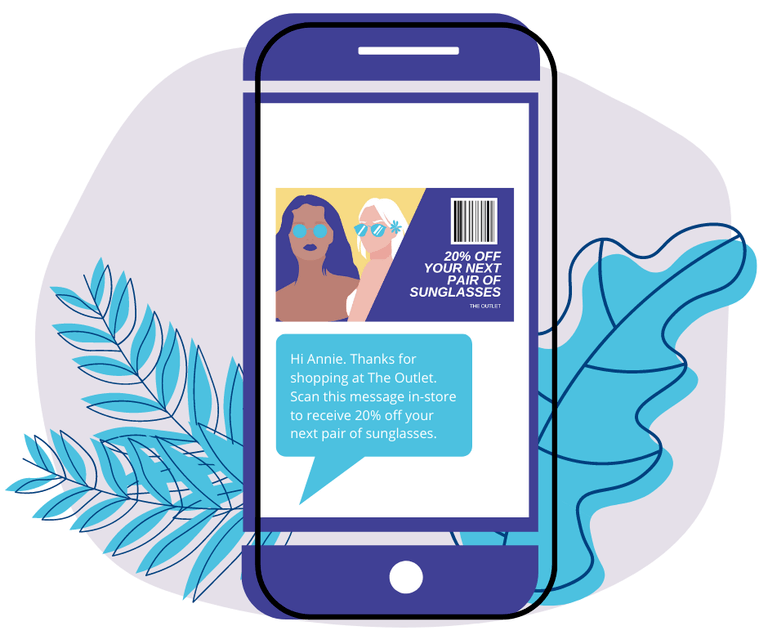
    • Sending gift card barcodes to redeem in-store or online

    Source: www.voicesage.com 

    Send automated customer discounts via SMS

    Delivering discounts via SMS is a great incentive, as customers love to save money and communicate on a large scale. Giving that it’s such a familiar channel that everyone is using, take advantage of its benefits. 

    For instance, choose SMS to send an automated discount code to a customer when they sign up to your loyalty program or offer 20% off their next order when they make a purchase.

    Incentivize reviews 

    Start collecting user-generated content such as reviews. This way, you increase product engagement, differentiate yourself from the competition, and it allows you to engage with your customers at a personal level.

    The more positive reviews you have, the better the customer engagement. Share that on your top-level pages or throughout the entire website to create an on-going positive experience.

    Source: www.voicesage.com 

    Increase customer retention

    Customers become loyal to an ecommerce business when the products are high quality, delivered as quickly as possible, and when you invest in making the customer experience as smooth as possible.

    These are just a few of the factors that increase the likelihood of retaining customers. Implementing a customer loyalty rewards program that works for your brand starts with knowing your customers. Take a minute and analyse your data and analytics. See how your customers react to promotions, what they like and dislike, and what your competition is delivering. 

    This process will give you enough information to design the best reward program.

    Conclusion

    In conclusion, repeat orders are more like to happen when customers see a benefit from a loyalty marketing program. Start investing in mobile programs as they are cheaper, more scalable, and instant. Then you will see positive growth.

  • How to Start Marketing Your Ecommerce Store on Pinterest in 2021 & Why You Should

    How to Start Marketing Your Ecommerce Store on Pinterest in 2021 & Why You Should

    Ecommerce businesses have larger potential audiences than ever before thanks to the far reach of the internet and the relative affordability of national and international shipping, but they’re also facing more competition than ever before. A small clothing business in Colorado can now reach customers in Germany… but that means businesses in Germany can reach customers near you, too.

    To thrive in the ecommerce world today, it’s crucial to know how to leverage the right marketing platforms so that you can better connect with and sell to your audience.

    Pinterest should be a go-to marketing platform for ecommerce businesses of all shapes and sizes in 2021, and in this post we’re going to go over why it’s so important and how to get started. 

    Why Pinterest should be your go-to marketing platform

    Pinterest is a high-value marketing platform that your audience will likely use to discover and research items before purchasing. There’s an abundance of proof that Pinterest frequently drives direct conversions, including the following:

    • 73% of users purchased something after seeing it on the platform 
    • High-income users are 2x more likely to use Pinterest than low-income homes, meaning the disposable income is more readily available
    • Pinners start the buying and planning process 2x earlier than other consumers on average
    • 39% of female users and 48% of male users will turn to Pinterest’s search engine for shopping decisions before “traditional” options like Google or Bing 

    People are using Pinterest to find new products, and if you aren’t on the platform, there’s a solid chance that you’re missing out on those sales as a result. 

    How to get started marketing your ecommerce store on Pinterest 

    There are several essential factors to consider when you’re ready to start marketing on Pinterest. You’ll need to set up a profile, work on strong content development, create engaging images, and connect Pinterest to your overall marketing strategy.

    You can get a comprehensive overview in this free Quickstart course here, but let’s take a look at the basics that you absolutely need to know now. 

    Setting up your profile 

    Start by setting up a business profile on Pinterest. This (as opposed to a personal profile) will give you access to analytics and the ability to run native ad campaigns. 

    Credit: Pinterest

    To create a strong profile, you should do the following:

    • Make sure your name is easily identifiable, using your brand name if possible 
    • Choosing the same profile picture that you’re using for other social media channels for increased visibility and brand recognition
    • Including keywords in your description, which should explain what your business does and what you can offer on Pinterest, to help users find your content and see that it’s relevant to them
    • Fill out all relevant fields, including your website address, so users can connect with you off-platform, too
    • Take time to claim your website through Pinterest, which will allow you to gain enhanced analytics and give you perks like having your profile picture show up in pins from your site

    Focus on educational, valuable content when possible 

    Pinterest is a place where people come to research, so while of course you’ll want to have product pins that link directly to product pages to promote sales, think outside the box, too. If you’re able to create valuable, educational content that your target audience would love, that’s a great way to steer them to your brand.

    A great example of this is Fenty Beauty. Their “shop” tab is filled with product pins, but you can also find an enormous library of pinned tutorials showing people how to use the products. This can drive immediate sales, and it’s a fantastic strategy. 

    Credit: Pinterest

    Creating engaging, click-worthy images

    Images are everything on Pinterest. Visuals are central to the platform, and the reality is that if they aren’t great, you’re unlikely to see a lot of traction here even if the content itself is solid.

    Consider testing images that have two or three bright, dominant colours, and unlike Instagram, you don’t need to worry quite as much about lots of negative space; close-up images often perform well here.

    In order to speed up visual creation, look into third-party tools like Tailwind that can help with image generation. You can have the tool automatically pull images from the site or upload them yourself, add text, and then choose different formatting and colour palettes to create a number of dynamic, visually-optimised pins in a matter of minutes. 

    Credit: Pinterest

    There’s no graphic design experience needed, and you’ll still end up with pins that look professionally-created. 

    Credit: Pinterest

    Connect Pinterest to your overall marketing strategy

    While Pinterest is an exceptional platform on its own, you’ll really have the best results with it if you connect it to your overall marketing strategy instead of treating it like a truly standalone entity. 

    See where Pinterest fits into your digital marketing funnel. If, for example, you’re able to send users from a pin to an educational blog post, you can use a CTA in that blog post to get them to sign up for your email newsletter. From there, you can use triggered autoresponders to follow up and nurture them into customers. 

    Plenty of pinners, after all, will likely add items to their cart before abandoning them for some reason. The ability to email someone within 12 or 24 hours after they’ve abandoned a cart with a coupon code can earn you a sale and a new customer. You can also set up PPC campaigns to retarget to users who added items to their cart but didn’t purchase, making your Pinterest marketing more effective. 

    Final thoughts

    Pinterest is an ecommerce marketing powerhouse, and that will hold strong through 2021. If you aren’t already using and prioritising the platform, the time to change that is now. Even though it does create one more profile that needs to be managed, the potential payoff here is massive, and if you don’t get started, there’s a good chance that you’re just handing your competition sales that should have been yours. 

    Keep in mind with all the resources and tools like Tailwind now available to brands and marketers, Pinterest marketing is easier than ever, making that payoff even sweeter. 

    Ready to get started marketing your ecommerce business on Pinterest? Sign up with your free trial at Tailwind today. 

    Author bio: Ana Gotter is a strategic content marketer specializing in business, finance, ecommerce, and marketing writing, though she’s worked across a range of industries. She works from her home in Orlando with her three dogs and can be contacted at www.anagotter.com.


  • 7 Blogging Tips For Ecommerce Fashion Retailers

    7 Blogging Tips For Ecommerce Fashion Retailers

    Blogging is at the heart of content marketing strategies for most ecommerce fashion retailers, but there’s a lot of fashion-related content already out there to compete with. 

    You’re up against some of the biggest retailers out there — not to mention thousands of fashion bloggers, lifestyle bloggers, and influencers. So how can you stand out from the crowd and really make your ecommerce fashion blog shine?

    We’ve got you covered. Here are seven blogging tips for ecommerce fashion retailers that will help increase traffic to your blog and improve your engagement with shoppers: 

    Start from the beginning with your ecommerce fashion blog 

    If your ecommerce fashion store has had a blog for a while then you’ve probably done audience research before, but it’s important to keep it up to date. 

    If you don’t keep revisiting your audience research, then you’re going to end up making assumptions about what they want to read, what they’re interested in, what problems or concerns they’re looking to solve, and what blog content they’re going to engage with. 

    Ask for regular feedback and talk to your existing customers about why they chose your business, what their main motivations are for purchasing, and what content they want to see. 

    You can also monitor reviews on your site and on other sites for customer insights that they might not offer up when asked — you’ll be able to spot trends and problems that can inspire your blog posts. 

    Take UX tips from the best fashion websites

    Blogging for ecommerce fashion retailers isn’t as straightforward as writing down some great content and publishing it. 

    You need to consider the design, layout, and user experience (UX) of your blog (and your website). Taking inspiration from some of the best fashion websites out there can help you to up your game and compete with the best of them. 

    One of the best examples of a fashion website is Zara. The whole layout is simple and clean, without an overload of products and sales offers — it’s more like looking at a fashion magazine than an online store. 

    creenshot of the Zara homepage - one of the best fashion websites to take UX tips from.

    Image: Zara

    Wolf and Badger is another fashion retailer that has put together a fully responsive, intuitive website. It’s straightforward to navigate and showcases the full range of products effectively. 

    The Wolf and Badger blog (Magazine) is a seamless extension of their site, with all their posts set out in a clear, no-fuss layout. 

    Screenshot of the Wolf and Badgers blog homepage as an example of the best fashion websites.

    Image: Wolf and Badger

    Look at what independent fashion shops are writing

    You need to make your blog stand out by using a unique tone of voice and style that fits in with your brand and your products. 

    Start by thinking about what your brand stands for — what are your values? Why are you selling the products you sell? Focus on your target customers and how you would speak to them. 

    You can take inspiration from successful independent fashion businesses. Find a few that are selling something similar or targeting a similar market, and follow them on social media, sign up for the emails, and read their blog posts. You want to unpick how they communicate and engage with their readers and loyal customers. 

    A good example of a strong brand voice is independent fashion retailer, Lucy and Yak. They are known for selling ethically and sustainably made dungarees in a range of bright colours (as well as all sorts of other clothing and accessories). 

    The website makes it very clear what the brand stands for with a section called ‘What Matters To Us’, which covers their ethos, values, where their fabric comes from, who makes their clothing, and their suppliers. They aim to be completely transparent about how the business operates and their commitment to ethical practices, which is one of the things that really draws ethical consumers to them as a brand. 

    The Lucy and Yak blog fits in seamlessly with the brand. It’s bright and colourful but covering some difficult topics that align with their values such as fast fashion, racism, mental health, and sustainability. 

    Screenshot of the Lucy and Yak ecommerce fashion blog homepage.

    Image: Lucy and Yak

    Use brand storytelling in your ecommerce fashion blog

    Use your blog to tell a story to your customers and potential customers — it’s an opportunity to share your story and make your store seem more relatable to shoppers. 

    Consumers look for brands that have meaningful, inspiring stories, and are selling more than just a piece of clothing — they want to buy into the ideals.  

    For example, Seasalt is a brand that sells clothing inspired by the local area in Cornwall and the sea. Their clothing is colourful but practical, and uses patterns designed by local artists. 

    Their blog, Seasalt Stories, includes posts about their creative partnerships with artists and talks about how their clothing is designed and made. They also cover charity work, seaside travel destinations, and other content that’s relevant to their target audience such as gardening and home cooking — lifestyle ideals that will really resonate with their audience.

    creenshot of the Modern Creatives category page on the Seasalt blog.

    Image: Seasalt

    The blog captures the close ties with their local area, their commitment to sustainability, and the story behind the clothing. It gives readers an insight into the company and what goes on behind the scenes, helping them connect with the brand and align themselves with the brand’s values. 

    Sell a lifestyle through celebrity and influencer stories 

    Your blog shouldn’t just tell your own company story. You can also use it to share stories from customers, influencers, and celebrities. Your happiest customers — and relevant influencers — can help with brand advocacy and extend your reach. 

    One of the keys to a successful fashion retail blog is selling a lifestyle, not just focusing on selling your products. You need people to invest in a lifestyle that they can achieve by purchasing your products.

    You could start off by finding your ‘best’ customers (either with the most orders, or positive reviews), and reaching out to them about being featured in your blog. Alternatively, monitor your mentions on social media to find brand advocates and influencers that may be interested in working with you. 

    It’s important to demonstrate how your clothes are worn and used in real life situations. Collaborating with influencers is an important part of ecommerce marketing because it can help you to connect with your target audience, build trust, and convince them to buy. It could even be worth launching an influencer marketing program to drive more traffic to your online fashion shop, 

    Address the pain points experienced when buying from online clothes shops 

    One of the biggest pain points for online fashion shoppers is not knowing how the clothes are going to fit. Using your blog content to address these issues is an important part of convincing readers to convert into shoppers. 

    Include posts about how different items of clothing will fit — for example, how to find out your measurements for suits or how to pick the right-sized trainers for running. You can also talk about how your range of clothing will fit, and the best way for someone to pick the right style for them. 

    For example, Levis has a whole page dedicated to explaining their range of jeans. Best of all, they have a Denim Dictionary which covers all their terminology, history, fabrics, and styles:

    Screenshot of the Levis’ Denim Dictionary website page.

    Image: Levi’s

    Write about how your ecommerce fashion store makes its clothes

    In the last few years, there’s been a spotlight on the pitfalls of the fast fashion industry. There’s much more awareness of the environmental impact that producing different fabrics has, the volume of cheap clothing that ends up going to landfills, and the poor working conditions in factories that make these clothes. 

    Shoppers now are much more interested in where their clothes come from, how they’re made, and the sustainability of them. They’re trying to move away from buying cheap clothing that’s only worn once, and this is an important conversation for ecommerce fashion retailers to participate in. Beyond this, shoppers are looking for clothing that makes a statement and aligns with their own values and interests. 

    One of the key topics your blog can cover is the full story of where and how your clothing is made. 

    This shouldn’t be confused with the specific details you include in your product descriptions. But what your blog post can do is talk about the types of fabric used, whether it’s sustainable or recycled, your manufacturing process, and the people who are making your clothes. 

    It can also cover insights into the design process and the designers behind the pieces — such as what inspires them to create these clothes, and how they intend for them to be worn. 

    Create ‘how to’ content for your ecommerce fashion blog

    Style guides, tutorials and other ‘how to’ content is a great way to provide extra value for your customers. By offering useful resources that align with your company, you’re going to be making stronger connections with your target audience, while also promoting your clothes and products. 

    The ASOS blog is a great example of incorporating ‘how to’ content into an ecommerce fashion blog. Their guides cover putting together outfits for specific occasions, how to customise or update your clothes, makeup tutorials, and guides to buying different products. 

    Screenshot of the ASOS blog, with examples of how to guides for fashion ecommerce.

    Image: ASOS

    They also mix up the format of their blog content with lots of images and videos to keep readers engaged. By providing all this useful content, ASOS are positioning itself as the one place to go for fashion advice and tips — which will hugely increase brand awareness and the reach of their posts. 

    Blogging for ecommerce fashion retailers relies on a mix of different content that’s all focused on providing a better experience, more value, and creating a real connection between the brand and the customer. 

    These blogging tips for fashion ecommerce are just some of the ways in which you can engage more with your audience and increase sales. Focus on this, and your ecommerce fashion blog will really shine.

  • 4 Incentives Your Online Business Can Use To Attract New Customers

    4 Incentives Your Online Business Can Use To Attract New Customers

    If you’re looking to grow your online business then reaching new audiences and converting them into paying customers is going to be essential. But how can you do this?

    In the article below, we take a look at four incentives your online business can use to attract new customers. Read on for inspiration. 

    Set up a referral scheme

    Once you’ve got a loyal base of customers who are happy with your products or service, you can use this to draw in new customers. 

    It’s likely that happy customers will recommend your business to others at some point anyway, but you can be proactive and create a referral scheme that encourages them to do so.

    To start with, you need to ensure that you are providing the best possible experience for your customers — so once someone makes a purchase, send a follow-up email and ask for any feedback, offer additional advice or relevant products. Take on board any feedback you’ve been given by customers, and work on areas in your sales or fulfilment processes that might need improving and the product or service itself. You don’t want to ask customers to refer your business to someone unless they are completely satisfied with the experience.

    Once you know a customer is happy, you can send them details of your referral scheme. For example, you could ask them to score how satisfied they were with their experience out of ten, and then share the referral scheme with customers that answer eight or above.

    When you’re setting up a referral scheme, it’s important to make sure it’s worthwhile for both your business and the customer. You don’t want to make it easy for people to refer others and access a considerable discount if those that they refer never make a purchase — but you also don’t want the process to be so complicated that the customers don’t benefit from it. 

    Many businesses will provide customers with a referral code to share, and if someone signs up or makes a purchase using that code then they get a discount or offer, and the customer that referred them also gets a reward.

    Referral schemes are a great way to engage with your existing customers and attract new customers at the same time.

    Create a limited time offer for new customers

    Special discounts and offers are a great way to hook new customers. If someone’s been considering purchasing or signing up, then a special offer is going to help convince them to go for it.

    To maximise the effectiveness of a new customer discount, ask people to sign up to your email list to receive the discount off their first order. This way if they don’t end up ordering even with the discount, you have their contact details and you can send them further marketing emails and tailored discounts that will encourage them to buy.

    When someone does purchase, make sure you track what they’ve ordered and ask them to sign up for an account so you can store their details. Not only will this mean it’s easier for them to check out again in the future, but you’ll also be able to send them personalised emails with relevant products and offers. 

    If you’re offering a new customer discount it’s always important to make sure that you’re able to turn them into a repeat customer by providing them with a great experience and keeping them engaged.

    Run a loyalty scheme

    Another great incentive you can use to attract new customers and encourage them to keep coming back is a loyalty scheme. 

    A good loyalty scheme can make shoppers feel like they’re getting better value and could encourage them to buy from your business over one of your competitors. It’s also great for customer retention. The information that you collect from customers who sign up to your loyalty scheme will give you a better insight into their interests and preferences, so that you can target your marketing more effectively — and keep your customers happy.

    To start a loyalty scheme, you need a clear idea of what you’re trying to achieve, and it could be worth asking for feedback from existing customers on your ideas. Popular loyalty schemes often involve collecting points that add up to money off or discounts, or more tailored, exclusive offers that change as customers shop more often.

    If you want to attract new customers then you could include an additional incentive — such as bonus points — on your first order. 

    Whatever you decide, it’s important to find the right balance between offering good value that will attract new customers, but not devaluing your products or ending up losing money.

    Social media competitions

    Running a social media competition is a great way to increase your reach and awareness of your business, and can be an attractive incentive to new customers. You’ll be able to get your followers talking about your brand, interacting with your posts, and sharing it so that it reaches a wider audience — and people who haven’t purchased from you will enter the competition as well.

    In order to run a successful social media competition, you need to be really clear on the goals you’re trying to achieve. If you’re aiming to find new customers, then it needs to reach new audiences. The prize also needs to be something that would appeal to potential customers as well as existing customers — they could be winning your most popular product or a credit to spend in your store.

    Start by outlining your goals and budget so that you know what you’re working with and how you can measure the outcome. 

    Then decide on the rules for entry and the prize. You need to make it simple enough to enter that people aren’t put off, but don’t make it too easy and ensure that you get enough engagement. Ask people to comment or share posts and tag other users as entries to the competition.

    It’s also important to be clear about the rules and deadlines for entry, any location-based restrictions, and also to make sure that it complies with the social media platform’s rules. 

    And once you’ve decided on how you’re going to run the competition, you need a plan for how you’re going to promote it. You can use a range of channels — share it via email marketing, on your website, and consider promoting your social media posts so that it reaches people that might not be following your account.

    If you’re looking to attract new customers to your online business, you need to start by reaching out to them and making them aware of your business.

    Once you’ve hooked them, you can then use incentives such as a loyalty scheme, discounts, or competitions to persuade them to make their first purchase.

  • 5 Customer Retention Strategies That Are Ideal For Online Businesses

    5 Customer Retention Strategies That Are Ideal For Online Businesses

    One of the huge advantages of brick-and-mortar retail is that a fantastic location can do most of the work for whichever seller is fortunate enough (or sufficiently forward-thinking) to secure it. Set up a convenience store immediately outside a train station, for instance, and you’ll barely need to put any effort into reaping the rewards. You’ll be the default choice.

    When you move into the world of online business, you largely take location out of the equation, and shoppers suddenly have access to a nearly-boundless pool of alternatives. Whatever edge you lean on to get people through the door (so to speak) can be dulled at any moment. If you have the cheapest prices, someone can beat them. If you have the biggest range, a competitor can significantly expand theirs. That means you can’t rely on new business to the same extent.

    As a result, you don’t just need to work harder to bring in fresh prospects: you also need to make a concerted effort to keep the customers you’ve already won over. Loyal customers spend more, complain less, drive referrals, and are more receptive to marketing materials. If you can master the art of customer retention, you can proceed with a lot more confidence.

    To that end, we’re going to take a look at five customer retention strategies that all online businesses should consider implementing. Let’s get started.

    Provide exceptional customer support

    Sooner or later, the average customer will need some kind of assistance. Maybe one of their orders will be delayed, or they’ll be uncertain about which item to choose between two similar products. When that happens, they’ll want some official support — and the nature of the support they’re able to find will heavily determine how they view the business.

    Improving customer service is all about being accessible, consistent, efficient, and dedicated. It isn’t good enough to rely on a sluggish ticketing system. Whenever you can, use options like live chat and social engagement to deal with issues as quickly and usefully as possible. Do a great job, and you’ll no doubt secure some lasting loyalty.

    Iterate based on customer feedback

    The worst thing a modern company can do is stagnate, because there are countless operations out there that are consistently investing in development. Whether it’s the quality of your products or the functionality of your website, you need to fight to maintain an excellent standard — and it’s essential to remember the people you’re trying to impress.

    When you make significant changes to your business, the people most affected will be your long-term customers — and if they don’t appreciate the changes, you’ll have a difficult time convincing them to stick around. Due to this, you should make customer feedback an integral part of your corporate development process.

    Don’t just make changes because you want them. Find out what your customers want, then iterate your store with those preferences in mind (improving your customer experience). You don’t have to do everything they ask for (and probably couldn’t, since they won’t all want the same things), but if you roll out some desired changes and let people know about them, you’ll earn a lot of valuable goodwill.

    Address all social media negativity

    The social media world tends to reveal and intensify problems, and businesses that don’t pay attention to it inevitably get blindsided by its brand-damaging power. 

    Suppose that someone has a bad experience with your company and wants to complain about it. If they don’t believe you’re likely to make things better, they won’t complain to you: they’ll complain to their friends, and they’ll most likely complain via their social media accounts (probably tagging your company along the way or by simply writing on your posts).

    If you miss that negativity, it’ll only fester. That’s why you need to not only notice it (quickly, it bears adding) but also take action to address it by engaging with anyone and everyone who speaks ill of you online. 

    Don’t be aggressive, but don’t meekly accept responsibility either. Give each complainant the benefit of the doubt and investigate their problem. If it’s your fault, do what you can to fix it. If it isn’t, make it clear that everyone else knows that.

    Implement a good loyalty program

    When you’ve been a loyal customer for a certain company for a long enough time, you can start to feel that you’re being taken for granted. It’s particularly frustrating when the company seems obsessed with bringing in new customers. Think about how ISPs (Internet service providers) tend to operate. They offer all the best deals to prospective customers so they can bring them in.

    If you want to keep people around, you should take the opposite tack: give your best deals to the customers who’ve supported you for a long time. 

    Implementing a loyalty program is the way to go, ensuring that there’s a clear system through which extended patronage will earn people various rewards (discounts, advance notice of new products, better support, etc.).

    Show company personality and ethics

    People these days want more than just great prices and strong service from the brands they support. They also want to like them and consider them laudable somehow — and what makes a brand likeable is having personality and caring about more things than money. Showing personality highlights the people behind a business, making it harder for customers to view it as a faceless and apathetic monolith.

    As for caring about things beyond money, it’s become normal for companies to talk about their ethical commitments. What are you invested in? What causes do you support? Maybe you’re doing what you can to encourage sustainability, for instance. 

    If so, be sure to talk about it, making it part of your general marketing strategy. Customers who respect your values will probably stick with you even if competitors can beat your value proposition.

    If you do whatever you can to keep your customers around, they’ll reward you by spending more and giving you unyielding support. You’ll always need to bring in some new customers, but this approach takes a lot of the pressure off lead generation, allowing you to relax somewhat and focus on improving your business.

  • How To Use Trust Signals To Let Customers Know Your Website Is Safe

    How To Use Trust Signals To Let Customers Know Your Website Is Safe

    It’s easy to think of online shopping as safe to the point of being anodyne, but this is a result of sticking exclusively to the most well-known stores. Of course you’re going to have a decent experience ordering something through Amazon: it’s a corporate juggernaut with ceaseless investment in being the default ecommerce option. And if you can get everything you need through the usual suspects, then maybe you don’t need to worry about security…

    …Except that approach supports a status quo that would utterly doom your ecommerce store. 

    You need shoppers to expand their horizons, looking to support smaller retailers and ensure that profits aren’t completely swallowed up by a handful of companies. If they won’t wander off the beaten path and take a chance on an unknown seller, you can’t make any progress, and your only option is to operate solely through third-party marketplaces.

    You don’t want that, obviously. You want to maintain your independence by running your own dedicated store and growing your brand into a success that doesn’t need to piggyback off the architecture of bigger sellers. But if you’re going to achieve that success, you need a plan to convince prospective buyers that your website is just as reliable as sites like Amazon.

    In this post, we’re going to explore how you can use trust signals to convince visitors to your site that it deserves their trust, ultimately pushing them to give you opportunities to win them over. What are trust signals, and what actions should you take? Let’s get into it.

    What are trust signals, exactly?

    The term trust signal is extremely broad, referring in this context to anything someone can find on your website that will make them more likely to trust your company. 

    You can, of course, have signals that provide the opposite effect. Think of egregious typos in your homepage copy, implausible prices or claims about order turnaround, or clear inconsistencies in your company details (suggesting that they’ve been altered or entirely fabricated).

    When someone who doesn’t know much about your brand arrives at your website, they’ll be unconvinced but have an open mind. Your task is to seize the chance to convince them that you’re worth their time and money. If you don’t, they’ll go elsewhere, and you’ll lose out.

    Mention payment security credentials

    One of the biggest concerns people have when buying online is keeping their financial details safe. After all, they’re often called upon to volunteer their card information, and that information could easily be abused. 

    To reassure them that they can order through your store without major risk, you can mention whatever payment security credentials you can muster.

    The easiest inclusions are supported third-party gateways that are already trusted, with PayPal being the obvious example. If you make it clear that you accept PayPal payments, people will know that they can trust your payment process to a reasonable extent (after all, they’ll have the option of seeking recompose through that service in the event that they’re unhappy).

    And if you take card payments directly, you should have security safeguards in place, so let people know which ones. What schemes are you registered to? What standards do you adhere to? Security badges pertaining to governing bodies can be very influential.

    Prominently display social proof

    Who wants to be the first person to order from a new website? It isn’t very appealing because it involves charting unknown territory. It’s far better to wait until some others have tried it first, as you can see what their experiences are like. This is part of the power of the social proof, and the part that pertains most strongly to security and safety.

    The other part, of course, more closely resembles peer pressure. The more people buy from your store and comment on it positively, the more popular your brand will be, and the more eager others will be to order from you. There isn’t always wisdom in crowds, but ecommerce is one arena in which mass interest and approval tends to indicate a decent company. You can also draw upon customer approval to power an affiliate marketing strategy.

    Beyond just including a broad array of reviews, consider picking out some comments that relate to security and putting them on your homepage. The ideal review would outline some initial hesitation (mirroring what most people will be feeling) before making it abundantly clear that there was never any need to be hesitant — but if you have no such review, make the best of the comments you do have.

    Offer clear terms and conditions

    Ecommerce isn’t as simple as exchanging money for goods. 

    There are complicated terms and conditions involved: even if you don’t directly comment on them because you don’t have any, your store will be subject to the default terms and conditions for an operation of its type. And the thing about terms and conditions is that the notable absence of them is cause for concern.

    Why would you omit such things if you had no issue with customers reading them? And if you don’t want customers reading them, it raises the question of what you’re trying to conceal. By making it easy for people to review your terms and conditions, you can show that you have nothing to hide and are eager to always operate with transparency.

    You don’t need to overload your website with trust signals, but they’re definitely important. 

    Revisit your website from the perspective of someone unfamiliar with it, and consider how it comes across. What needs to be in place to make it seem trustworthy? Figure that out, then add the necessary trust signals.

  • How To Use Gamification To Build Brand Loyalty

    How To Use Gamification To Build Brand Loyalty

    Any modern business that isn’t investing heavily in brand loyalty is leaving revenue on the table.

    In a time of intense competition and narrow margins, relying on the ability to bring in new prospects is a huge mistake. When leads start to dry up — and they always do — the results are inevitably catastrophic. But loyal customers will always be there to support you.

    There are various viable approaches to earning brand loyalty, though, so it isn’t as simple as following a set formula that will compel your customers to stick around. You need to decide which tactics are suitable for your business in particular, and come up with a decent plan for implementing them effectively.

    In this post, we’re going to look at one tactic in particular: namely gamification. This is the process of drawing upon game-design principles to create enhanced customer experiences that are significantly more engaging and can encourage users to stick around for longer. Enough preamble: let’s go through some core tips for using it to your advantage.

    Make your user interface optimally easy

    One key ingredient of gamification is animated feedback following actions. 

    In a game, after all, the player needs to know the consequences of everything they do so they don’t waste time and effort trying tactics that won’t work. This is also important for customer experience. When you hover over a button, something should indicate that clicking it will have an effect. When there’s a field that needs to be filled in, it’s standard to highlight it in a red hue to make it more noticeable.

    By reviewing the entirety of your website’s user interface, you can pick out the parts where it’s anything less than abundantly clear what actions need to be taken, and you can draw upon the game design playbook to make improvements that will keep users moving in the right direction. Remember that your animations and tweaks don’t need to be showy — just useful.

    Keep people updated on order progress

    Just as your site should indicate when actions have been taken, it should also keep customers updated on order progress. The less information you provide, the more probable it will be that your customers will become frustrated with your store. 

    Consider the remarkable precedent set by other top brands that draw upon mobile apps to provide rich updates. Often, consumers know everything about their product’s journey — from the moment their order is received, to when it is dispatched from the warehouse, to the exact time it will arrive by courier at their doorstep. 

    Just as a game questline needs clear steps, your order process needs distinct parts that can be checked off to keep the customer informed. In addition to helping achieve and maintain loyalty, this will significantly reduce your need to provide customer support: if someone can see exactly where their order is in the fulfilment process, they won’t need to reach out to you.

    Present the purchase thresholds for rewards

    Assuming you have a comprehensive customer loyalty system in place (you certainly should), it’s worth thinking about how clearly it functions. Do you provide rewards on an ad-hoc basis, deciding when a customer has been with you for long enough? Do you have a tier system in place somewhere but communicate it poorly? Neither approach is ideal.

    Instead, you should not only have a clear set of reward tiers, but you should also provide progress on the thresholds from the very first purchase. 

    If a customer can see every time they open their account exactly how far they are from earning admission to the next loyalty tier, it’ll push them to keep spending and reach that milestone — and it’ll be great for driving referrals.

    Add elements of customer comparison

    Why do customers want to hit reward tiers? For the rewards, of course (they can be quite substantial for big customers), and for the simple dopamine hits of achieving those minor goals.

    But there’s another factor that should be taken into account: competitive drive. We all compare ourselves to our peers, after all, and it can be used to motivate us to act.

    Video games have high scores and leadership boards so everyone knows which players are the best. While you shouldn’t take things that far, you should think about including statistics pertaining to customer habits: for example, you could tell a particular customer that they’re the biggest buyer of a particular item, and give them a discount as a reward. And if you told the second-biggest buyer of that item, you might motivate them to go for the top spot.

    These are just some of the ways in which you can use elements of gamification to earn and maintain brand loyalty. After all, gamification is such a rich subject that there are so many more to be found. Start with these tactics and see how you get on.